About Us

MD‑Konsult is an independent research firm based in Dallas. We publish deep dives on AI economics, GTM, and pricing for SaaS and SMB leaders.

Our Approach

Evidence‑backed insights for founders who care about ROI, not hype.

Showing posts with label startup. Show all posts

How To Find the Right Co-Founder For Your Startup

Navigating the Co-Founder Landscape: A Guide for Aspiring Entrepreneurs

Navigating the Co-Founder Landscape: A Guide for Aspiring Entrepreneurs

Summary:

Finding the right co-founder can be a game-changer for startups, but it's not always necessary. This comprehensive guide will help you determine if a co-founder is right for you, where to find them, and how to build a successful partnership. Learn about the pros and cons of having a co-founder, the importance of complementary skills, and how to navigate equity splits.

Key Takeaways:

  • Co-founders can amplify your startup's potential, but they're not always essential.
  • Finding a co-founder with complementary skills and a shared vision is crucial for long-term success.

Do I Need a Co-Founder?

The decision of whether or not to have a co-founder is a personal one, and there's no one-size-fits-all answer. While it's entirely possible to build a successful business solo, having a co-founder can offer significant advantages. A co-founder can help you:

  • Divide and Conquer: Share the workload, reducing stress and burnout.
  • Leverage Diverse Skills: Bring complementary expertise to the table, strengthening your team.
  • Provide Emotional Support: Offer companionship and encouragement during challenging times.
  • Align with Successful Models: Many successful companies, such as Apple, Google, and Facebook, were founded by co-founders.

Where to Find Your Ideal Co-Founder

Finding the right co-founder can be a challenge, but there are several effective strategies to consider:

  • Tap Your Network: Start by exploring your existing network of colleagues, classmates, and friends. You likely already know their character and work ethic.
  • Leverage Online Communities: Join industry-specific forums and groups to connect with like-minded individuals and potential co-founders.
  • Attend Industry Events: Hackathons and startup events provide opportunities to meet other entrepreneurs and potential co-founders.
  • Utilize Co-Founder Matching Platforms: There are platforms dedicated to connecting aspiring entrepreneurs with compatible partners.

Testing Your Co-Founder Compatibility

Before committing to a partnership, it's crucial to assess your compatibility with a potential co-founder. Consider these tips:

  • Collaborate on a Small Project: Start with a low-stakes project to evaluate your working styles and communication skills.
  • Have Open and Honest Conversations: Discuss your goals, values, and expectations for the business.
  • Assess Your Communication Styles: Ensure you can effectively communicate and resolve conflicts amicably.

How Many Co-Founders Are Optimal?

While two co-founders is the most common setup, the ideal number can vary depending on your specific circumstances. Having too many co-founders can lead to decision-making paralysis and equity dilution, while having too few can limit your resources and perspectives.

Equity Splits: A Delicate Balance

Determining how to split equity among co-founders can be a complex and sensitive issue. It's essential to have an open and honest conversation about your contributions and expectations. Here are some factors to consider:

  • Initial Investment: Who is contributing more capital to the business?
  • Time Commitment: How much time is each co-founder dedicating to the business?
  • Skills and Expertise: What unique skills and expertise does each co-founder bring?
  • Future Roles: Who will assume leadership positions within the company?

Finding the right co-founder can be a challenging but rewarding endeavor. By carefully considering your needs, researching potential partners, and testing your compatibility, you can increase your chances of building a successful and enduring partnership.

Share:

How to Stand Out in the Crowded Startup World: 4 Simple Tips

How to Stand Out in the Crowded Startup World: 4 Simple Tips

How to Stand Out in the Crowded Startup World: 4 Simple Tips

Key takeaways:

  • Solve a real problem that your target market faces and offer a unique value proposition that addresses it.
  • Build a strong brand that resonates with your audience and reflects your mission, vision, and values.
  • Leverage social proof to increase your credibility and trustworthiness and showcase your value and popularity.
  • Experiment and iterate constantly to find the best product-market fit and growth strategies for your startup.

The startup world is highly competitive and saturated. According to the Global Entrepreneurship Monitor, there were over 582 million entrepreneurs in 2019. How can you make your startup stand out from the crowd and attract customers, investors, and talent?

Here are four simple tips to help you differentiate your startup and achieve success.

1. Solve a Real Problem

The first and most important tip is to solve a real problem that your target market faces. Don’t create a solution in search of a problem. Instead, identify a pain point, validate it with research, and offer a unique value proposition that addresses it.

For example, Airbnb solved the problem of finding affordable and authentic accommodation for travelers2. Uber solved the problem of getting a reliable and convenient ride. Dropbox solved the problem of storing and accessing files across devices.

2. Build a Strong Brand

The second tip is to build a strong brand that resonates with your audience and reflects your mission, vision, and values. A brand is more than just a logo, a name, or a slogan. It’s the personality, voice, and story of your startup.

A strong brand can help you create an emotional connection with your customers, differentiate yourself from your competitors, and increase your brand awareness and loyalty.

For example, Apple built a strong brand around innovation, design, and simplicity. Nike built a strong brand around inspiration, empowerment, and performance. Starbucks built a strong brand around community, quality, and experience.

3. Leverage Social Proof

The third tip is to leverage social proof to increase your credibility and trustworthiness. Social proof is the phenomenon where people tend to follow the actions or opinions of others, especially when they are uncertain or unfamiliar with something8.

You can use different types of social proof to showcase your startup’s value and popularity, such as customer testimonials, reviews, ratings, case studies, endorsements, awards, media mentions, social media followers, etc.

For example, Shopify uses customer testimonials and case studies to showcase how its platform helps entrepreneurs start and grow their online businesses. Slack uses customer logos and quotes to showcase how its software helps teams collaborate and communicate better. Netflix uses ratings and recommendations to showcase how its service helps users find and enjoy the best content.

4. Experiment and Iterate

The fourth and final tip is to experiment and iterate constantly to find the best product-market fit and growth strategies for your startup. Don’t be afraid to test new ideas, measure the results, and learn from the feedback. Don’t be satisfied with the status quo, but always look for ways to improve and innovate.

Experimentation and iteration can help you discover new opportunities, optimize your performance, and avoid costly mistakes.

For example, Facebook experiments with new features and algorithms to enhance its user experience and engagement. Amazon experiments with new products and services to expand its market and customer base. Google experiments with new technologies and solutions to solve the world’s biggest problems.

Conclusion: Standing out in the crowded startup world is not easy, but it’s not impossible either. By following these four simple tips, you can differentiate your startup and achieve your goals. 

MD-Konsult: We're not your average consultants. We're the cool kids who know the secret sauce to startup success (it's not ramen noodles, but it might involve pizza) - Let's connect!


Share:

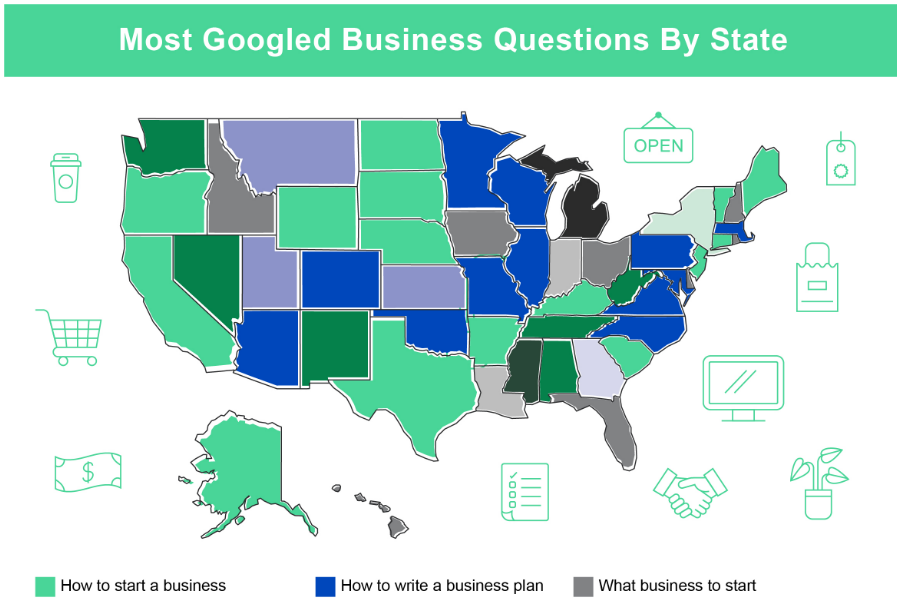
What are the Answers to the Top 3 Most Googled Small Business Startup Questions

https://business.centurylink.com/resources/wp-content/uploads/2022/06/Most-Googled-Business-Questions_Map_V2.jpg

What are the Answers to the Top 3 Most Googled Small Business Startup Questions

On our Business Fundamental 101 Channel on Quora, we've seen a common trend and proposed responses to Top-3 questions: How to Start a Business? What Business To Start? How To Get Funding? Now CenturyLink has compiled a list of startup questions across different states in US, based on most Googled and we're not surprised to see, the trend is very similar to what see from our user.

Methodology used by CenturyLink was to use SemRush, a tool used by marketing professions (and us as well), to gather data on most Googled business centric keywords. The top ten results were then ran through Google Trends, providing insights into the Top-3 questions by state, collected from April 2021 to April 2022.

Here are the Top-3 Questions:

  1. How to Start a Business?
  2. How to write a Business Plan?
  3. What Business to Start?

As MD-Konsult is focused on SMB (Small Medium Business) and Startup consulting, we would be remiss, if we did not share how we broach these questions with our founders. Below is how we start and guide our founders:

1. How to Start a Business?

Important question, but this is not the right question to start with. "What Business to Start" is where the magic happens. We recommend, the readers to read that first and then come back to this, even though this question is addressed first. At a high level here is what we recommend.

A. If you are familiar with different type of incorporations, using LegalZoom is probably the fastest way to incorporate a business.

B. For first time founders, especially if its more than one founder, we suggest going through a legal entity, who specialize in startups. This is critical for future decisions.

2. How to Write a Business Plan?

We've made is simple, by creating "Free & Editable" templates either ourselves, or from other resources. Click here for free business templates.

Pause: We do not recommend founders to start with a Business Plan. Why? Our experience shows that due to the length of the document, it can become a deterrent very quickly. 

Recommend: We recommend to start with a Business Model Canvas (BMC). They key tenants of a BMC allow the founders to validate their hypothesis very quickly and then graduate to the Business Plan. Also, based on where the funding is coming from, a Business Plan (at the onset), may not provide the value most believe it does.

3. What Business to Start?

Based on our many engagements with founders and startups, this is the starting question. Nothing matters more than right idea / hypothesis. We also recommend our founders to translate the idea into a "Hypothesis". This forces the founders to think in terms of outcomes and for whom.

Once done, the hypothesis is then expanded upon through a BMC. Once BMC is ready and viable, incorporation is done and we go into hyper drive mode of testing with users. Post user feedback, the Business Plan is then crafted, which clearly lays out key areas of focus.

Final Thoughts:

We at MD-Konsult, are a startup business that forces on the startup business. Our Experience, independent of industry, provides our founders a structured approach to start a business. There will always be challenges, but the best way is to be prepared and agile enough to manage the risk. If 90% of the startups are statistically failing, we want to improve the probability of success. Connect with us at MD-Konsult.com

Share:

How Do Private Companies Value the Equity of Their Stock

Source: https://upload.wikimedia.org/wikipedia/commons/f/ff/House_Prices_Rising_-_51244998966.jpg

How Do Private Companies Value the Equity of Their Stock

For Publicly traded companies, there are many levers to calculate the value of the stock. It's also quite easy to do baseline the stock price compared to other companies in the industry. The financials are also reported and in many cases available for public consumption. 

On the other had, for Private companies, usually offer equity stake (though stocks) in the company, to raise capital and attract talent to the company. Since, the company is private, or a startup, to value the stock is more of an art than a science. This is where IRS Section 409A valuation comes into the picture.


Ads help us serve our growing community.

What is a 409A valuation and Who can perform this?

The story dates back to the Enron scandal, when in 2001 regulators looked for ways to plug the loopholes used by Enron executives. As a result, IRS introduced Section 409A in 2005, finalizing it by 2009.

Section 409A is a framework for private companies to adhere to, when valuing private stock. The key tenant is that valuation is conducted by an unaffiliated or independent party. This practice establishes a safe harbor, meaning the 409A valuation is presumed to be “reasonable” by the IRS.

IRS provides three safe harbor methods for setting the Fair-Market-Value (FMV) of private company common shares:

  • Independent appraisal presumption
  • Binding formula presumption
  • Illiquid startup presumption

The most common approach to achieving 409A safe harbor status is using a qualified, third-party appraiser The cost for 409A valuations can range anywhere from $1,000 to over $10,000, depending on the size and complexity of the company. 

When should 409A Valuations be Triggered?

A 409A Valuation needs to be done prior to startup offering equity stake in the company. IRC 409A valuations are valid for a maximum of 12 months or until a “material event” occurs. 

For startups, an initial financing is the most common material event. Other material events could be acquisitions, divestitures, secondary sales of common stock, business model pivots, and missing or exceeding financial projections. In essence a 409A valuation should be done:

  • Before issuing first common stock options
  • After raising a round of venture financing
  • Once every 12 months (or after a material event)
  • When approaching an IPO, merger, or acquisition

What are 3 most common 409A methodologies?

There are three standard methodologies used by Independent appraisers to obtain the FMV.

1) Market approach (OPM backsolve)

Market based approach uses financial information like revenue, net income, and EBITDA from comparable public companies to estimate the company’s equity value.

For new startups, when initial round of financing is raised, investors usually get preferred stock and employees common stock. This creates different classes of security. To address this complexity, Option based valuation method (OPM backsolve) is used. The principle that the OPM backsolve method is based on is that an economic relationship exists between the various classes of securities. Therefore, when the value of a single class of equity is known, this method provides the ability to determine the value for all other equity-related securities.

2) Income approach

This approach is used for businesses with sufficient revenue and positive cash flow. This method defines company’s FMV as its total assets minus its corresponding liabilities. 

3) Asset approach

The approach is used for early-stage startups that have yet to raise capital and do not generate revenue. This methodology calculates a company’s net asset value to determine a proper valuation.

Key Takeaways:

For startups that are looking into raising capital or getting ready for a material event to transpire, should engage with reputable third-party firms to perform 409A valuations. 

In the larger scheme of things, this will ensure that startup is less likely to be audited and penalized by IRS and no penalties are incurred by stakeholders.

Share:

4 Ways to Start a High-Growth Business With Zero or Minimal Funding 


Video summary of the article:

4 Ways to Start a High-Growth Business With Zero or Minimal Funding 

By far, one of the most recurring questions we address on our Quora channel, is related to starting a business with Zero or Minimal Funding. Having a global audience on this channel, we know that this problem statement is a global phenomenon. 

We've also gleaned insights about misconception, related to the sources of capital -  primary assumption being venture capital. There is also lack of understanding on how to broach a startup in general. These topics will be addressed in future articles.

Here we provide 4 options to kickstart your entrepreneurship journey with minimal to no funding.


Ads help us serve our growing community.

1. Bootstrapping

Bootstrapping is either putting up your own money on the line or reach out to your family and friends to help launch your business. Bootstrapping will force founders to think lean. Every decision will come with the sacrifice of something else, so you'll need to fully understand your business and financial state, at any given moment.

The lean approach will also force you to validate assumptions quickly, align with customer expectation and pivot as needed. Bootstrapping makes you appreciate your business more because you are personally invested. It also creates a culture where exceptional performance is the norm and the team is fully accountable to meet the goals. Lean times may be rough, but it will make each success that much more rewarding.

2. Leverage Government & Small Business Grants

Start by searching grants from the Federal government at Grants.gov. This site has the most comprehensive database of funds the government is going to give away. There are thousands of grants to apply for, with opportunities for businesses from all backgrounds.

There are many nonprofit and corporate entities offering grants and other assistance to small businesses. A few examples: 

Business Warrior Small Business Loans, FedEx Small Business Grant, Walmart Local Community Grants. SCORE, which can assign a volunteer business mentor who can provide guidance on numerous topics, including funding and operations.

3. Sell your Services Through a Subscription Model

Subscription businesses that ensure product/market fit and successfully capture customer obsession, can count on subscribers to stick around for the long haul, yielding huge benefit. 

Additionally, digital payments platforms such as PayPal, Stripe, and Square have made it possible to set up and process recurring payments without the massive investment of manpower that was once required.

For consumers, subscription business models provides predictability, convenience and simplicity. Angel investor Eric Stromberg notes:

“Subscription is a powerful business model because it creates an environment where the default customer behavior is retention, as opposed to one where the default behavior is churn.”

The key to this model's success is ensuring continued product/market fit. 

4. Sell your Frameworks (Best Practices)

All professionals use frameworks. A framework is a step-by-step process to create a hypothesis and validate experiment to reach a goal. Well-defined frameworks separate professionals who win, from hacks that can only dream of success. Consulting firms like McKinsey, BCG have perfected the art of monetizing frameworks.

It's also very common to see frameworks being introduced as part of business case studies. In a recent Entrepreneurship program at Harvard we picked up the POCD framework. Whilst not completely new, this frameworks helps entrepreneurs become more strategic.

Key Message:

Don't let lack of capital get in the way of brining your idea to life. Equally important is not let failure define your success. As Scott Cook - CEO of Intuit, has shared in his story - he started with bootstrapping, got the to verge of failure and then saw a hockey stick effect in growth.

Share:

What 30K Data Points Revealed About Why Certain Startups Reach Billion-Dollar Valuations

Ali Tamaseb, a founder turned venture capitalist and partner at DCVC, in his book Super Founders, has taken a data driven approach to identify and demystify traits that lead to startups reaching billion dollar valuations.


Video summary of the article:


Ads help us serve our growing community.
The approach:

According to Ali, he spent over 4 years, collecting over 30,000 data points from over 200 startups that had reached a unicorn status i.e billion-dollar valuations. Ali in a recent Inc, article wrote that:
I analyzed more than 65 factors per company: everything from a company's early competitors to the timing of its fundraising rounds to its founder's age and university ranking. No study is meaningful without a control group, so I also collected the same data on a similar-size group of randomly selected startups founded in the same time period (between 2005 and 2018) that didn't go on to billion-dollar valuations.
What is key Super Power of Super Founders?

Based on the data collected, Ali concluded that, the key trait or super power of billion-dollar startups founder is....
History of entrepreneurship, whether that's building a company, a side hustle, or a smaller project. Those who had created something that generated value--even on a small scale that would be considered a failure in the venture capital world--were more likely to go on to found billion-dollar companies than those with shiny resumes filled with brand-name employers and universities. 
The myths debunked:

Through his research, Ali also debunked a few myths, associated with founders.

1) Most founders of unicorns did not have experience in the same industry - Only 30% of tech startup and 40% of Enterprise/SaaS space had previously worked in industry. 

2) The vast majority of successful companies faced robust competition - 85% of startups had pre-existing competition and 50% were competing against incumbents. Companies with big competitors were more likely to become unicorns. 

3) Solo founders were not less likely to build billion-dollar startups - Ali found that the number of founders had no correlation to success.

Takeaways:

Founders should focus on creating and capturing value. Start with the fundamentals of identifying a need (or a problem), run quick experiments to validate the idea, create Minimum viable products and then focus on scale.
Share:

A New Platform, Where Successful Entrepreneurs Are Giving Away Their Unused Ideas


Ryan Holmes, founder of Hootsuite with help from his studio team, Alex Simpson, Paul Donnelly and Joel Hansen, have formed a new platform called Kernal. The idea of this platform is to have successful entrepreneurs share their unused ideas online - and they are open to others materializing them. According to the Kernal team:
“We realized that there are platforms for products (ProductHunt.com), questions (Quora.com) and fundraising (Angellist.com), but there isn't a platform for people to share and validate ideas to see if they’re worth pursuing,” Hansen said. “Rather than letting great ideas die in notebooks/google docs, we built a space for entrepreneurs to find, share and grow more startup ideas.”

Ads help us serve our growing community.
Our consulting team has applied to gain access to the platform, as they are invite-only for now. In the meantime, here 3 out of 10 ideas that Hansen has shared with the larger community, which our team found intriguing. 

1. A communal tool shed for neighborhoods
“What if there was a communal shed in the neighborhood that was fully loaded and you just had to use your phone to unlock and sign out what you needed?” asks Mike Parkhill, who posted this idea. 
Users would pay a monthly or annual fee to access it, and therefore wouldn’t need to buy and maintain their own tools. Here's a screen shot about how the idea was submitted and feedback on the idea.


2. “Shadow A CEO” Courses and Programs

“Follow a CEO for a day and take detailed notes: How do they email? How do they manage their calendar? How do they make decisions?” writes Trevor McKendrick, chief of staff at Lambda School, who posted this idea. 
“People will be shocked how quickly CEOs move on BIG issues and decisions. Do it for 10 CEOs and package that into a program. Having access to those details would be huge.”


3. Classpass for Conferences

Why pay for lots of conferences individually, when you could buy an annual membership that gives you access to a wide range of conferences around the country or world? That’s the idea here. 
“Conference organizers would like this as a way to presell tickets,” writes Rob Stretch, who proposed this one. “The difficulty would be in figuring out the math of how many people are actually likely to attend each one.”


As Kernal is in its early stages, it's difficult to ascertain what their own business model is and how do they plan to monetize the platform. It's also not clear what legal claim the idea submitters may have, if there idea became the next billion dollar opportunity. We'll keep on looking into this and share updates as they become available.

Share:

Lean startup - Common startup mistakes that Entrepreneurs can avoid


In his book, The Lean Startup, Eric Ries, has very succinctly shared and made a case that, "Entrepreneurship is akin to management". Before we dive into this statement, let's unearth a few other key takeaways in the book.

The book starts with Eric sharing his own story at a startup (IMVU). It's the fundamental for what follows in the book. At a startup, Eric was given the responsibility of designing an offer that would allow user to use the instant messaging (IM) and 3D avatars to communicate. As a software engineer, Eric and co, leveraged the lean principles to deploy code fast. The product came about quickly and was ready. Venture capitalists (VC) also backed the idea as novel and prime for making a successful business. At the onset the idea led to great product, albeit never aligned with the consumer appetite.


Ads help us serve our growing community.

First Takeaway: You can have a great product, but if you have the right answer to the wrong problem, there is a lack of product/market fit.

As eluded to earlier, Eric and his team were very influenced by the lean principles, which they successfully applied to the code development. This is where the second takeaway comes into view. 

The backdrop here that most founders believe that progression will be linear. The reality is that there will failures along the way. These are not business failures, rather outcomes of experiments done with customers, to validate the offering. When Eric's team ran such experiments, they found customers had no appetite to use their product. "Why do I need an add-on to my IM?", highlighting the fact customers simply did not understand the value. Therefore, customer saw no reason to invite others to use the product leading to zero network effects as result. 

Second Takeaway: The faster you can pivot, the faster you can incorporate the voice of the customer into the product. Expedite the build, measure, learn loop. 

Going back the opening statement, "Entrepreneurship is management", the book highlights an interesting point. Entrepreneurs are everywhere - implying that this trait is not limited to the generalized view of few guys working in garages, consuming pizza and soda, working on building the next revolution. Rather, it's a skillset that can found in any size organization. It's the responsibility of the leadership to create an environment, where experimentation is cherished and nurtured.

Another aspect to consider as part of management is what is to referred as "Innovative accounting". Eric points out that sometimes firms are so focused on creating the hypothesis and experiments, leading to minimum viable products (MVP's), that they overlook how to measure outcome. The book proposed the 3 A's method to measuring: Actionable, Accessible and Auditable. For e.g: Using total numbers of visiting users provide no value compared to number of percentage of new registered users.

Third Takeaway: Define metrics that are allow for creating a value drive baseline. Leverage this baseline to measure success and define experiments.

Without going into details, there is also a need to highlight some areas, which apply to different aspects of the takeaways.

MVP: First off MVP's may not be cheap and firms can utilize many different approaches. 

Video MVP: Create a video showing how the product is solving the problem. Used by Drew Houston for Dropbox.

The Concierge MVP: Work directly with a handful of customers. The technology might not be built yet, but the direct interaction is providing the feedback loop needed to build the product. Used by Food on the Table.

The Wizard of Oz MVP: Customers believe the technology is place; however manual work is being done behind the scenes. Used by Zappos.com, to validate if customers will by shoes online.

Landing Page MVP: The product is pitched via landing page. If the customers click to buy it, then it proves there is demand. Be mindful of this approach in the current instant gratification phase of consumerism. 

Crowdfunding MVP: Leverage sites that allows consumers to buy your product by providing an early payment. The payment is used to build the product and can have long lead times. Same as with landing page, be mindful of the approach.

To wrap-up, Lean startup provides strong arguments on how to approach Entrepreneurship through Lean approach. It also clarifies a few misconceptions about lean startup not being a cheap alternative, specific to technology startups and only data driven. The principles defined in the book are applicable to any startup, though Lean startup does showcase how to speed them up successfully. 

Share:

LinkedIn Top 5 startup list of 2021


On Sep 22, 2021, Linked published its 5th annual LinkedIn Top Startups list. LinkedIn analyzed startups between July 1 2020 and June 30, 2021, using their internally methodology, some tenants of which are:


Ads help us serve our growing community.


  1. Independently or privately owned, but no more than 7 years old

  2. Must have their head quarter in the US

  3. Must have at least 50 employees 

  4. Employment Growth (15% or more over the time horizon)

  5. Other


Based on the aforementioned criteria, the Top-5 startups, as ranked by Linked are:


5) Brex - Offers an all-in-one finance platform for businesses

Capital Raised: $940 Million in venture capital

Employees: 750+ employees with hubs across major US cities

Valuation: $7.4B as of 2021 (Source: Tracxn)


4) Discord - An online voice, video, and text communication platform designed for creating communities

Capital Raised: $500M in Series H round.

Employees: 550+ employees

Valuation: $15B as of 2021 (Source: Tracxn)


3) Glossier -  Direct to consumer beauty company

Capital Raised: $80M, Series E, Jul 06, 2021

Employees: 250+ employees

Valuation: $1.8B as of 2021 (Source: Tracxn)


2) Gong - Revenue intelligence platform that delivers insights at scale

        Capital Raised: $250M, Series E, Jun 03, 2021

Employees: 600+ employees

Valuation: $7.2B as of 2021 (Source: Tracxn)


1) Better.com - Platform for residential mortgages

        Capital Raised: $500M, Series E, April 01, 2021

Employees: 9000+ employees

Valuation: $1-10B as of 2021 (Source: Crunchbase + PrivCo)


Interesting insight from LinkedIn across Top-50 startups is that the majority of the positions they are hiring for are virtual. These companies are not wasting time debating whether virtual or in office is the right option, rather they are attracting the talent to help them scale. 


Share: