About Us

MD‑Konsult is an independent research firm based in Dallas. We publish deep dives on AI economics, GTM, and pricing for SaaS and SMB leaders.

Our Approach

Evidence‑backed insights for founders who care about ROI, not hype.

Showing posts with label Small Business. Show all posts

What is a SWOT Analysis and How to Apply it to a Small Business?

https://upload.wikimedia.org/wikipedia/commons/thumb/0/0b/SWOT_en.svg/427px-SWOT_en.svg.png

What is a SWOT analysis and how to apply it to a small business?

A SWOT analysis is a strategic planning tool used to analyze the strengths and weaknesses of a company or organization. It helps us identify areas where we can improve, as well as those that are already great.

The acronym stands for “strengths, weaknesses, opportunities, and threats.” The key to using this technique is understanding what each of these terms means:

Strengths – These are things about your business that make it unique and special in its field.

Examples include: having multiple locations throughout the country; having an excellent product line; having an established reputation for quality service; being known for innovation (for example, developing new products); providing personalized customer service...etc. 

Weaknesses – These are things about your business that may make it less competitive than other companies in your industry or even in other industries altogether. 

Examples: They could represent a lack of resources such as money or personnel, poor management practices like not keeping up with technology changes (or worse), etc., but they also could indicate poor marketing strategy on behalf of your company which leaves potential customers unaware of how good you really are! 

Opportunities – Your strengths should be able to yield opportunities when combined with certain strategies and tactics that will help you take advantage of them! 

For example: You have been building up loyal customers over time through word-of-mouth advertising (which has helped build up brand recognition). Now you have some cash reserves from years past profits which allows you to invest more into marketing efforts so that people know who you are now and become aware when new products come out! 

Threats – When there is something negative affecting one area — either internally within our own company or externally from competitors — then we need to find ways around it before it becomes overwhelming! 

Examples: A threat can come from many sources including economic conditions (like unemployment) which affect sales volume or government regulations like environmental laws which affect production costs or natural disasters such as fires destroying buildings…etc. In any case if there is something negative impacting one area we need to find ways around it because if left unchecked this weakness will impact our ability to compete effectively against other organizations/companies!! 

How to apply this framework for a small business? 

Here is an easy way to see how this works: 

1) Identify all the Strengths 

2) Identify all the Weaknesses 

3) List all possible Opportunities 

4) List all threats 

5) Make a Plan of Action to Capture Opportunities, Mitigate Weakness and Threats 

6) Implement the Plan of Action 

7) Measure the results 

8) Redefine and Reset every year 

This simple process can be used over and over again throughout any period during which changes occur within any given small business!!

Summary: 

A SWOT analysis is a method of analyzing the strengths, weaknesses, opportunities and threats (strengths, weaknesses, opportunities and threats) that affect your business. The goal of a SWOT analysis is to help you identify what factors are most important in making business decisions. It helps you decide which areas need improvement and lets you prioritize them for action. 

Connect with MD-Konsult:

MD-Konsult.com, is a boutique consulting firm, with a focus on startup and small businesses. Reach out to us, as we are in the business of creating and capturing value for our clients.
Share:

Key Metrics that Small Businesses should Measure

https://upload.wikimedia.org/wikipedia/commons/e/ed/Revenue11.jpg

What Key Metrics Should Small Businesses Measure

There is no one-size-fits-all answer to this question, as the key metrics for a small business to be profitable vary depending on the business type and industry. However, there are some general metrics that all small businesses should track in order to gauge their profitability, and these can be divided into two main categories: financial metrics and operational metrics.

Financial metrics are obviously important, as they provide insights into the financial health of a business. Key financial metrics for small businesses include gross margin, operating margins, net profit margin, and return on equity. Operational metrics, on the other hand, provide insights into the efficiency and effectiveness of a business's operations. Key operational metrics for small businesses include customer satisfaction, employee productivity, and quality control.

4 Metrics that Small Business Should Measure (as applicable):

  • First, small businesses should track their revenue and expenses. This will give you a clear picture of how much money is coming in and going out, and will help you to identify areas where you can cut costs or increase revenue.
  • Second, small businesses should track their customer acquisition and retention rates. This will help you to see how effective your marketing and sales efforts are, and whether or not you are losing more customers than you are gaining.
  • Third, small businesses should track their employee satisfaction and turnover rates. This will help you to see if your employees are happy and engaged, and whether or not you are losing valuable employees to turnover.
  • Finally, small businesses should track their Net Promoter Score (NPS). This metric measures customer satisfaction and loyalty, and can be a good indicator of future profitability.
The specific metrics that are most important for a small business will depend on the particular industry and business model. However, all small businesses should track both financial and operational metrics in order to get a complete picture of the business's performance.
Share:

Which 3 Networking Groups Should Every Small Business Owner Be Involved In

Which 3 Networking Groups Should Every Small Business Owner Should Be Involved In? How should small business network? Why is networking important for small business? Which 3 Networking Groups Should Every Small Business Owner Should?

Which 3 Networking Groups Should Every Small Business Owner Be Involved In

Building relationships may help you identify new possibilities and accelerate your company growth in ways you couldn't otherwise, especially if you surround yourself with the appropriate people. 

Most individuals see the value of networking but are unsure where to begin, or they have a distorted view of what networking is. Fortunately, there are several successful methods for connecting with other company owners. 

Here are three networking organizations to consider if you're searching for some inspiration:

1. SCORE

SCORE is a wonderful resource to look into if you're searching for a business mentor. SCORE has a large network of free volunteer mentors and offers courses, webinars, and information on how to establish a business. The US Small Business Administration provides funding to the organization (SBA).

2. Business Networking International (BNI)

Business Networking International (BNI) is an international networking organization with over 10,000 chapters concentrating on referral business.

When you join, you'll begin forming relationships with like-minded people and discovering new possibilities through referral marketing. BNI is especially beneficial for owners of service-based businesses that rely largely on recommendations. If you wish to learn more about the organization, seek for your local branch.

3. Chief (Dedicated to Empowering Women)

Chief is a networking organization dedicated to empowering women in business, with members ranging from Fortune 500 CEOs to successful startup founders. When you join a networking organization, you never know what you'll receive, but Chief gives you access to a verified community of experts.

As a member, you'll be assigned to a peer group led by an executive coach. Members can also attend workshops, member gatherings, and community groups. If you want to learn more, you may join the organization.

How to network effectively?

Networking can help your business expand, but only if you approach it strategically. Here are some pointers for efficiently networking with other business owners:

Be Selective: You can't attend every event or chat to everyone, your focus should be on quality rather than quantity. Spreading yourself too thin will just dilute your efforts, and you may have a bigger effect by deliberately selecting which networking events you attend.

Attend in-person events: While internet networking is useful, meeting in person is the greatest method to create contacts. Look for industry-related events, such as conferences or trade exhibits. Arrive with the intention of meeting and engaging with other experts in your field.

Maintain Contact: If you meet someone at a business event, make a point of getting their contact information. Knowing their email address and/or LinkedIn profile will make it easy to contact them afterwards.

Share:

How Can Startups Grow and Scale Using Artificial Intelligence in 2023? Our 3 Recommendations

https://upload.wikimedia.org/wikipedia/commons/5/51/Artificial_Intelligence%2C_AI.jpg

How Can Startups Grow and Scale Using Artificial Intelligence in 2023? Our 3 Recommendations

Big Tech has had a rough year. The FANG+ stock market index, which follows the top ten technology companies, has down more than 40% this year. Meta, long the darling of Silicon Valley, has seen its price collapse by more than 70%.

One explanation for the fall is that these firms are being hammered by a perfect storm of antitrust restrictions, data privacy concerns, and regulatory scrutiny, all while operating in an unpredictable macroeconomic climate. While major tech investors are discounting risk and anticipating weaker growth in the future, entrepreneurs can achieve quicker growth by filling the holes left by incumbents - this creates a great opportunity for startups, especially in the space of Artificial Intelligence (AI). 

Until recently, the most advanced AI solutions were exclusively available to large, well-funded enterprises. That is no longer the case. As AI has become more ubiquitous, it has flowed down into a plethora of goods and services available to startups and small businesses, and it may be a game-changer for those that take advantage of it.

Here are 3 areas that startups can use AI to capture the market to grow and scale.

1. AI can produce valuable market intelligence, which can lead to sustained competitive advantage.

In any competitive market, startups must compete for market share with both long-established rivals and newcomers. As a result, it's vital to monitor rivals to understand where possibilities exist.

Crayon, for example, can collect hundreds of data sources in order to deliver real-time insights regarding rivals' movements. If competitors drop the price of a product, launch a new marketing campaign, or if someone posts a nasty internet review, it will track it down and report on it. According an expert in the filed,  "The world changes at a speed that's hard to fathom, so decision-making needs to be adjusted based on insights coming from data, accompanied by recommended actions. 'Survival of the fastest' is the rule today."

2. AI allows product-centric expansion for better customer experience.

Amazon pioneered this technique with its product suggestions, but startups can now utilize AI to deliver a totally tailored experience for their consumers, from personalized messages and search results to content recommendations and targeted marketing.

Startups such as Monos.com use artificial intelligence (AI) via product lifecycle management software to bring novel goods to market. Startups in the fashion sector, such as Stitch Fix and Mode.ai, employ machine learning (ML) to offer clothing to clients based on their previous purchase history and preferences.

This method necessitates a data-driven attitude. Startups must be able to acquire, clean, and analyze data in order to train AI models. As Big Tech is under pressure to innovate, startups utilizing AI have a real possibility to leapfrog them.

3. AI can help startups automate and scale, allowing for sustained profitability.

AI can help startups automate and grow their operations. This is especially critical for high-growth firms that need to scale their operations fast. A few AI based tools that can help automate, personalize and scale.

Chatbots: According to a report published by American Express, more than 40 percent of consumers want companies to focus on providing quick customer service. Using Machine Learning, Natural Language Processing (NLP), and Natural Language Understanding (NLU), AI chatbots may learn how to reply more naturally, correctly, and effectively, saving you time and money.

Emails: Emails are one of the most critical tools for any business, and how you utilize them may be the difference between a successful and a failing outreach effort. You can now customise your emails using AI depending on how the recipient opens and responds to different messages. This is accomplished through the use of a learning algorithm that improves its analysis with each contact.

Hiring & Talent Retention: A survey found that more than half of talent acquisition leaders believe that finding the right candidate from a large pool of applicants is one of the most difficult aspects of recruitment. Startups can use AI to conduct automated screening to weed out applicants who are unsuitable for the role.

To close, AI itself is maturing, but it's becoming more accessible to startups and small businesses. This also means that startups and small businesses need to leverage these tools or become obsolete - possibly at a faster pace than ever before. 

At MD-Konsult.com, we both leverage AI and guide our clients on how to leverage latest technology to increase margins, scale and sustain a profitable business. Ask us how!

Share:

What are the Answers to the Top 3 Most Googled Small Business Startup Questions

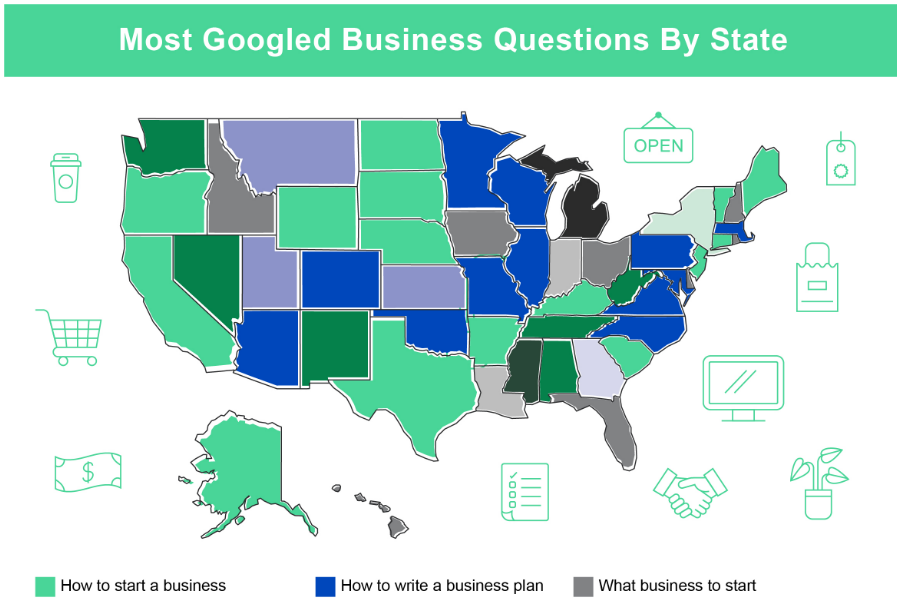
https://business.centurylink.com/resources/wp-content/uploads/2022/06/Most-Googled-Business-Questions_Map_V2.jpg

What are the Answers to the Top 3 Most Googled Small Business Startup Questions

On our Business Fundamental 101 Channel on Quora, we've seen a common trend and proposed responses to Top-3 questions: How to Start a Business? What Business To Start? How To Get Funding? Now CenturyLink has compiled a list of startup questions across different states in US, based on most Googled and we're not surprised to see, the trend is very similar to what see from our user.

Methodology used by CenturyLink was to use SemRush, a tool used by marketing professions (and us as well), to gather data on most Googled business centric keywords. The top ten results were then ran through Google Trends, providing insights into the Top-3 questions by state, collected from April 2021 to April 2022.

Here are the Top-3 Questions:

  1. How to Start a Business?
  2. How to write a Business Plan?
  3. What Business to Start?

As MD-Konsult is focused on SMB (Small Medium Business) and Startup consulting, we would be remiss, if we did not share how we broach these questions with our founders. Below is how we start and guide our founders:

1. How to Start a Business?

Important question, but this is not the right question to start with. "What Business to Start" is where the magic happens. We recommend, the readers to read that first and then come back to this, even though this question is addressed first. At a high level here is what we recommend.

A. If you are familiar with different type of incorporations, using LegalZoom is probably the fastest way to incorporate a business.

B. For first time founders, especially if its more than one founder, we suggest going through a legal entity, who specialize in startups. This is critical for future decisions.

2. How to Write a Business Plan?

We've made is simple, by creating "Free & Editable" templates either ourselves, or from other resources. Click here for free business templates.

Pause: We do not recommend founders to start with a Business Plan. Why? Our experience shows that due to the length of the document, it can become a deterrent very quickly. 

Recommend: We recommend to start with a Business Model Canvas (BMC). They key tenants of a BMC allow the founders to validate their hypothesis very quickly and then graduate to the Business Plan. Also, based on where the funding is coming from, a Business Plan (at the onset), may not provide the value most believe it does.

3. What Business to Start?

Based on our many engagements with founders and startups, this is the starting question. Nothing matters more than right idea / hypothesis. We also recommend our founders to translate the idea into a "Hypothesis". This forces the founders to think in terms of outcomes and for whom.

Once done, the hypothesis is then expanded upon through a BMC. Once BMC is ready and viable, incorporation is done and we go into hyper drive mode of testing with users. Post user feedback, the Business Plan is then crafted, which clearly lays out key areas of focus.

Final Thoughts:

We at MD-Konsult, are a startup business that forces on the startup business. Our Experience, independent of industry, provides our founders a structured approach to start a business. There will always be challenges, but the best way is to be prepared and agile enough to manage the risk. If 90% of the startups are statistically failing, we want to improve the probability of success. Connect with us at MD-Konsult.com

Share: